Why Stroke Matters
Stroke is a leading cause of global death and disability
Every year 12 million people experience a stroke. More than half will die.Two out of every three survivors - many of whom are young and active members of the global workforce - will be affected by significant long-term disabilities
Already one of the top 3 leading causes of global death and preventable disability, by 2050 the burden of stroke will increase by one third with a rise in the annual number of deaths to 9.7 million and global cost of US$1.6 trillion.
Stroke's impact isn't limited to patients alone
As well as coping with the emotional burden, families often take on the role of carer and have to cover the cost of treatment and rehabilitation. It is a really hard reality that pushes many people deep into poverty.
But it doesn't have to be that way
Stroke is Preventable
80% of the current stroke burden is linked to 10 modifiable risk factors. Identifying and managing hypertension alone could cut the rate of stroke in half.
Stroke is Treatable
Advances in treatments including thrombectomy and thrombolysis have revolutionized treatment options for patients,dramatically improving patient health outcomes, minimizing disability and reducing the economic impact of stroke on everyone.
Stroke is Recoverable
Access to rehabilitation and continuing care helps people regain independence, reduces the risk and cost of long-term disability, and has reduces the likelihood of recurrent stroke.
1 in 4 People will suffer a stroke in their lifetime
12m Every year there are 12 million new strokes
94m People are living with the effects of stroke
1.8m have a stroke before the age of 50

Non-communicable diseases (NCDs) kill an estimated 43.8 million people every year. Stroke is repsonsible for around 17% of these deaths, and yet the burden is often overlooked by a broader focus on cardiovascular disease (CVD).
It is an oversight that is costing lives and slowing progress towards agreed NCD targets.
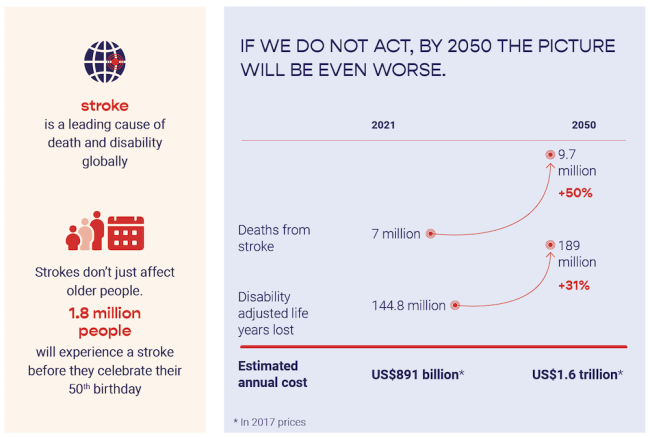
Stroke is a rising global health burden
The number of people affected by stroke has almost doubled in the past 30 years. Without action, that burden will continue to rise.
Pragmatic Solutions to the Global Stroke BurdenWe will not reach global goals to reduce the burden of NCDs or achieve universal health coverage if we do not invest in stroke
In line with broader global targets for health and sustainable development, an investment in stroke prevention, treatment and care will help:
Save millions of lives
Save millions of lives and protect the quality of life for millions more (SDG 3)
Promote long-term economic growth
Generating billions of dollars in savings on immediate healthcare costs (SDG 3)
Strengthen prevention in other NCDs
Investing in stroke will also strengthen prevention of a range of other NCDs
Stroke Stories
Read stories from people with lived experience of stroke, clinicians and specialists advancing access to quality care, and policy makers who are putting stroke on their national healthcare agenda


Coalition Leadership
The Global Stroke Action Coalition is a movement driven by the expertise, commitment and resources of all members. It is convened by the World Stroke Organization (WSO) as part of its global advocacy function. WSO is the only global stroke focused civil society organization in official consultative relations with the UN ECOSOC and is an official partner to the World Health Organization. The Coaltion Leadership Group is co-Chaired by WSO and has representation from of all Coalition partner organizations.
The Leadership Group provides strategic oversight and decision-making, supports coordination across all coalition activities, and ensures that the Coalition's goals and activities align with and contribute to our collectice mission.
Leadership Group Co-Chairs: Prof Bo Norrving and Prof Sheila Martins
Members Dr Jeyaraj Pandian, WSO President: Mia Grupper, WSO Executive Director; Representatives of American Stroke Association, Asia Pacific Stroke Organization, Chinese Stroke Association, European Stroke Organization, March of Dimes Canada, Stroke Association UK, Society for Vascular & Interventional Neurology.